
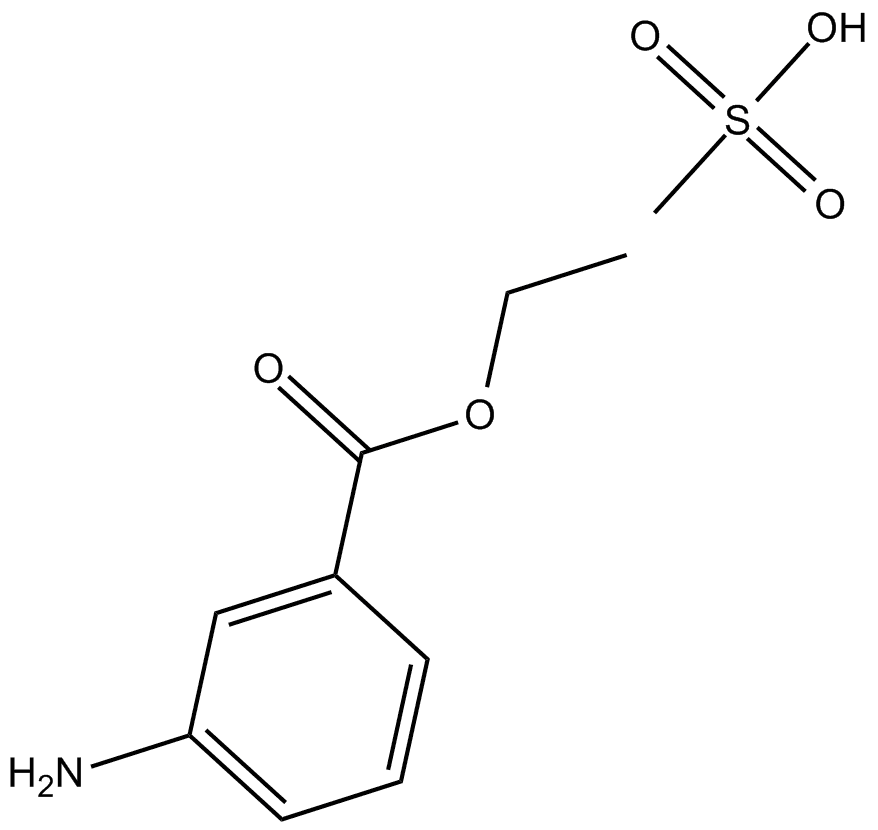
Ethyl 3-Aminobenzoate (methanesulfonate)
与电压依赖的Na+通道作用,阻断动作电位的产生
| 规格 | 价格 | 货期 | 数量 |
|---|---|---|---|
| 1mL(10 mM in DMSO) | ¥454.00 | 现货 | |
| 25g | ¥720.00 | 请咨询 | |
| 50g | ¥1347.00 | 请咨询 | |
| 100g | ¥2481.00 | 请咨询 |
特色产品
- 适用于流式细胞仪和荧光显微镜检测
- 准确区分活细胞/凋亡细胞/坏死细胞

- 用于免疫印迹和质谱分析等后续操作
- 适用于30 KDa-130 KDa大小的蛋白
- 对细胞无毒性
- 步骤更简单,无需有机溶剂

- 可将信号灵敏度提高100倍
- 同时保持稳定的特异性和分辨率
- 提供更高的转录效率并抑制免疫激活
- 使用5-moUTP和Cy5-utp修饰
- 优异的扩增效率、可重复性和稳定性
- 卓越的灵敏度和准确性,操作简单

- 优化的缓冲液和T7 RNA聚合酶混合物
- 20 μL反应体系可获得更高的RNA产量
产品描述
Ethyl 3-Aminobenzoate can block the generation of action potentials via voltage-dependent Na+-channels.
Sodium channels play a critical role in physiology: they can rapidly transmit depolarizing impulses throughout cells and cell networks, therefore enabling co-ordination of higher processes. Sodium channels are also of special importance for the history of physiology.
In vitro: The major mode of action for ethyl 3-aminobenzoate was found to be nervous system suppression whereby the entrance of sodium into the nerve was inhibited, therefore limiting nerve membrane excitability. In addition, the nerve inhibition was facilitated by the lipid solubility of ethyl 3-aminobenzoate, which allowed it to move easily into the cell membrane to bind with sodium channels [1].
In vivo: Previous study evaluated the potency and dynamics of ethyl 3-aminobenzoate-induced effects on neuronal firing of sensory and motor nerves alongside a defined motor behavior in Xenopus laevis tadpoles. Electrophysiological recordings of extraocular motor discharge and nerve activity were measured before, during and after administration of drugs. Results showed that ethyl 3-aminobenzoate and benzocaine, but not pancuronium could cause a dose-dependent, reversible blockade of extraocular motor and sensory nerve activity. Such results indicated that ethyl 3-aminobenzoate was able to block the activity of both sensory and motor nerves compatible with the mechanistic action of effective anesthetics, suggesting that ethyl 3-aminobenzoate was effective as single-drug anesthetic for surgical interventions in anamniotes [2].
Clinical trial: So far, no clinical study has been conducted.
References:
[1] K. M. Carter, C. M. Woodley and R. S. Brown. A review of tricaine methanesulfonate for anesthesia of fish. Rev. Fish Biol. Fisheries 21, 51-59 (2011).
[2] C. Ramlochansingh, F. Branoner, B. P. Chagnaud, et al. Efficacy of tricaine methanesulfonate (MS-222) as an anesthetic agent for blocking sensory-motor responses in Xenopus laevis tadpoles. PLoS One 9(7), e101606 (2014).
产品性质
| CAS号 | 886-86-2 |
| 分子式 | C9H11NO2·CH4O3S |
| 分子量 | 261.3 |
| 化学名称 | 3-amino-benzoic acid-ethyl ester, monomethanesulfonate |
| 溶解度 | ≥13.25 mg/mL in DMSO; ≥29.5 mg/mL in EtOH; ≥54.5 mg/mL in H2O |
| SMILES | CCOC(c1cc(N)ccc1)=O.CS(O)(=O)=O |
| 存储条件 | 室温 |
| 运输条件 | 蓝冰 |
产品应用 (实验数据来自文献,APExBIO并未验证,仅供参考)
IC50和靶点
| 生物活性描述 | 甲基磺酸三卡因(MS-222)常用于固定鱼类以进行标记或运输;以及在侵入性程序中抑制感觉系统。 |
| 靶点 | Sodium Channel |




 沪公网安备 31011002003500