
Naloxone (hydrochloride)
一种可缓解阿片类药物过量所致呼吸抑制的阿片受体拮抗剂。
| 规格 | 价格 | 货期 | 数量 |
|---|---|---|---|
| 100mg | ¥500.00 | 现货 |
特色产品
- 适用于流式细胞仪和荧光显微镜检测
- 准确区分活细胞/凋亡细胞/坏死细胞

- 用于免疫印迹和质谱分析等后续操作
- 适用于30 KDa-130 KDa大小的蛋白
- 对细胞无毒性
- 步骤更简单,无需有机溶剂

- 可将信号灵敏度提高100倍
- 同时保持稳定的特异性和分辨率
- 提供更高的转录效率并抑制免疫激活
- 使用5-moUTP和Cy5-utp修饰
- 优异的扩增效率、可重复性和稳定性
- 卓越的灵敏度和准确性,操作简单

- 优化的缓冲液和T7 RNA聚合酶混合物
- 20 μL反应体系可获得更高的RNA产量
产品描述
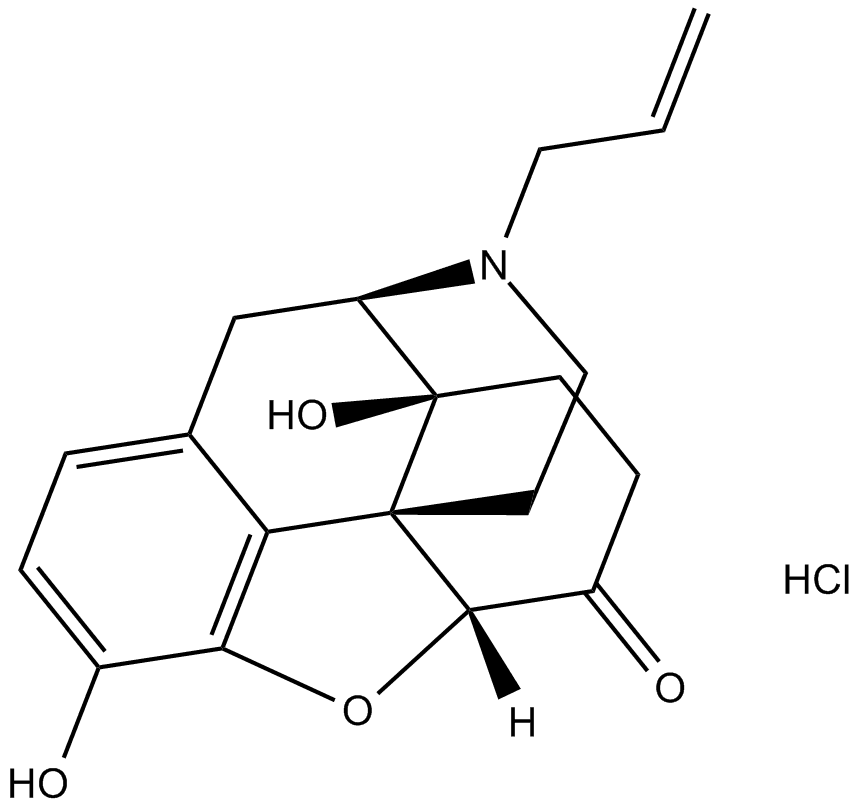
Naloxone (hydrochloride) is an opioid receptor antagonist [1].
Opioid receptors include 3 subtypes, namely, μ-, δ-, and κ-opioid receptors, which can be activated by various endogenous peptides, and also drugs of abuse such as morphine and heroin. Activation of opioid receptors leads to the regulation of many biological functions including pain perception, motivation, locomotion, hormone secretion, and reward [2].
In neural stem cells (NSCs), naloxone facilitated the proliferation of NSCs in a concentration-dependent manner. Naloxone at 1 μM increased the final number of NSCs to an even higher level than morphine at 1 μM, approximately 150% of the basal level [1]. In human peripheral blood mononuclear cells, naloxone triggered a significant reduction of natural killer cell activity only at very high concentrations, 1 × 10⁻³ M and above [3].
Naloxone (0.625, 2.5 or 10 mg/kg, i.p.) caused a dose-dependent reduction of break-points and locomotor activity in both the beer and near-beer rats. However, the effects of naloxone on breakpoints were significantly more pronounced on rats drinking beer compared to those drinking near-beer [4].
References:
[1]. Liang L, Chen J, Li Y, et al. Morphine and naloxone facilitate neural stem cells proliferation via a TET1-dependent and receptor-independent pathway. Cell Reports, 2020, 30(11): 3625-3631.
[2]. Gomes I, Fujita W, Chandrakala M V, et al. Chapter Nine - Disease-specific heteromerization of G-protein-coupled receptors that target drugs of abuse. Progress in Molecular Biology and Translational Science, 2013, 117: 207-265.
[3]. Adelson M O, Novick D M, Khuri E, et al. Effects of the opioid antagonist naloxone on human natural killer cell activity in vitro. Israel Journal of Medical Sciences, 1994, 30(9): 679-684.
[4]. Gallate J E, McGregor I S. The motivation for beer in rats: effects of ritanserin, naloxone and SR 141716. Psychopharmacology (Berl), 1999, 142(3): 302-308.
产品性质
| 物理外观 | A solid |
| CAS号 | 357-08-4 |
| 分子式 | C19H22ClNO4 |
| 分子量 | 363.84 |
| 小分子别名 | Naloxone hydrochloride |
| 化学名称 | (4R,4aS,7aR,12bS)-3-allyl-4a,9-dihydroxy-2,3,4,4a,5,6-hexahydro-1H-4,12-methanobenzofuro[3,2-e]isoquinolin-7(7aH)-one hydrochloride |
| 溶解度 | insoluble in EtOH; ≥12.25 mg/mL in H2O; ≥18.19 mg/mL in DMSO |
| SMILES | C=CCN(CC[C@]12c(c(C3)ccc4O)c4O[C@H]1C(CC1)=O)[C@H]3[C@@]21O.Cl |
| 存储条件 | -20°C |
| 运输条件 | 蓝冰 |
产品应用 (实验数据来自文献,APExBIO并未验证,仅供参考)
IC50和靶点
| 生物活性描述 | 盐酸纳洛酮是阿片受体的拮抗剂。盐酸纳洛酮可减轻阿片类药物过量引起的呼吸抑制。盐酸纳洛酮可能导致肺水肿和心律失常。 |
质量控制
操作说明
APExBIO 顾客使用本产品发表的 1 篇科研文献
- 1. Jinzhao Li, Yawen Zhang, et al. "Modulation of Tau Expression in the Colonic Muscle Layer of a Rat Model with OpioidInduced Constipation." Pakistan J. Zool., pp 1-13, 2023






 沪公网安备 31011002003500