
Alsterpaullone
CDKs和GSK3β抑制剂
| 规格 | 价格 | 货期 | 数量 |
|---|---|---|---|
| 1mg | ¥556.00 | 现货 | |
| 5mg | ¥2410.00 | 现货 |
特色产品
- 适用于流式细胞仪和荧光显微镜检测
- 准确区分活细胞/凋亡细胞/坏死细胞

- 用于免疫印迹和质谱分析等后续操作
- 适用于30 KDa-130 KDa大小的蛋白
- 对细胞无毒性
- 步骤更简单,无需有机溶剂

- 可将信号灵敏度提高100倍
- 同时保持稳定的特异性和分辨率
- 提供更高的转录效率并抑制免疫激活
- 使用5-moUTP和Cy5-utp修饰
- 优异的扩增效率、可重复性和稳定性
- 卓越的灵敏度和准确性,操作简单

- 优化的缓冲液和T7 RNA聚合酶混合物
- 20 μL反应体系可获得更高的RNA产量
产品描述
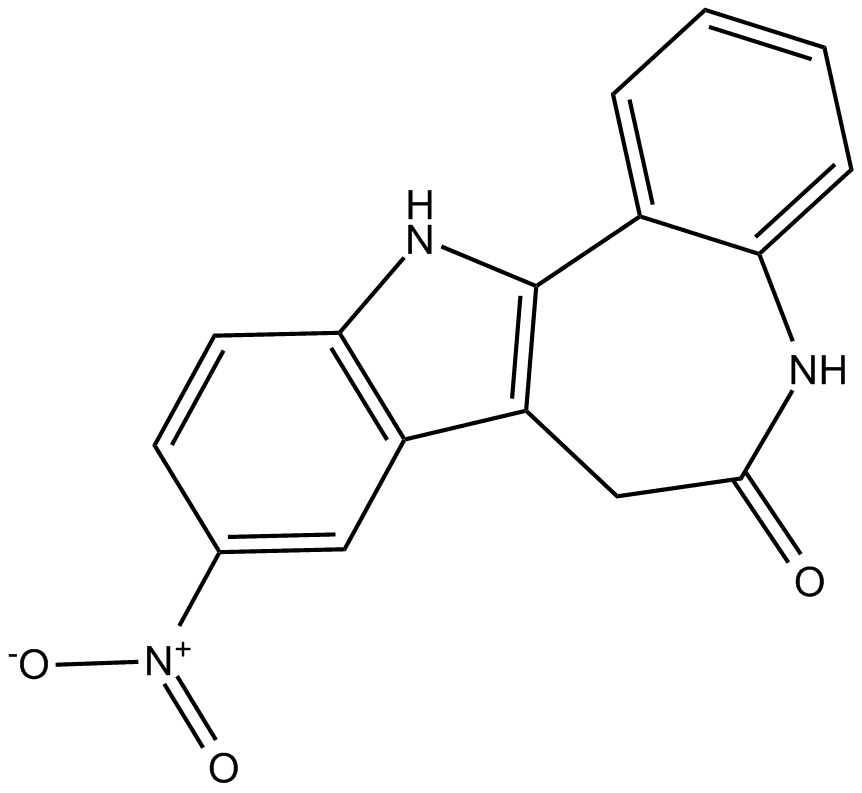
Alsterpaullone is a small molecule cyclin-dependent kinase (CDK) inhibitor [1,2].
Cyclin-dependent kinases (CDKs) are protein kinases that play important roles in the control of cell division and modulate transcription in response to several extra- and intracellular cues. Deregulation of CDKs is a hallmark of several diseases, including cancer, and drug-targeted inhibition of specific members has generated very encouraging results in clinical trials [3].
Alsterpaullone (Alp) induced apoptosis and promoted loss in clonogenicity in the Jurkat cell line. Alp activated both caspase-8 and -9, leading to cleavage of caspase-3 and poly (ADP-ribose) polymerase (PARP). Alp disrupted the activation of caspase-9 followed mitochondrial perturbation. Alp activated caspase-9 via mitochondrial perturbation [1]. Alsterpaullone regulated the cell cycle progression. Alsterpaullone inhibited HeLa cells in a time-dependent (0–72 h) and dose-dependent (0–30 μM) manner. Alsterpaullone arrested HeLa cells in G2/M prior to undergoing apoptosis via a mechanism that is involved in the regulation of various antiapoptotic genes, DNA-repair, transcription, and cell cycle progression. Alsterpaullone effectively prevented HeLa cells from entering S-phase [2].
References:
[1] Lahusen T, De Siervi A, Kunick C, et al. Alsterpaullone, a novel cyclin‐dependent kinase inhibitor, induces apoptosis by activation of caspase‐9 due to perturbation in mitochondrial membrane potential[J]. Molecular carcinogenesis, 2003, 36(4): 183-194.
[2] Cui C, Wang Y, Wang Y, et al. Alsterpaullone, a cyclin-dependent kinase inhibitor, mediated toxicity in HeLa cells through apoptosis-inducing effect[J]. Journal of analytical methods in chemistry, 2013, 2013.
[3] Malumbres M. Cyclin-dependent kinases[J]. Genome biology, 2014, 15(6): 122.
产品性质
| 物理外观 | Yellow to brown powder |
| CAS号 | 237430-03-4 |
| 分子式 | C16H11N3O3 |
| 分子量 | 293.28 |
| 化学名称 | 9-nitro-7,12-dihydrobenzo[2,3]azepino[4,5-b]indol-6(5H)-one |
| 溶解度 | insoluble in H2O; insoluble in EtOH; ≥11.1 mg/mL in DMSO |
| SMILES | [O-][N+](c(cc1)cc2c1[nH]c(-c(cccc1)c1N1)c2CC1=O)=O |
| 存储条件 | 4°C |
| 运输条件 | 蓝冰 |
产品应用 (实验数据来自文献,APExBIO并未验证,仅供参考)
IC50和靶点
| 生物活性描述 | 紫檀烷酮(9-硝基紫檀烷酮)是一种强效的 CDK 抑制剂;对 CDK1/细胞周期蛋白 B、CDK2/细胞周期蛋白 A、CDK2/细胞周期蛋白 E 和 CDK5/p35 的 IC50 分别为 35 nM、15 nM、200 nM 和 40 nM。紫檀烷酮还能与 ATP 竞争;与 GSK-3alpha/GSK-3beta 结合;IC50 均为 4 nM。紫菀酮具有抗肿瘤活性;并具有研究神经退行性疾病和增殖性疾病的潜力。紫菀酮可诱导白血病细胞株凋亡。 |






 沪公网安备 31011002003500