
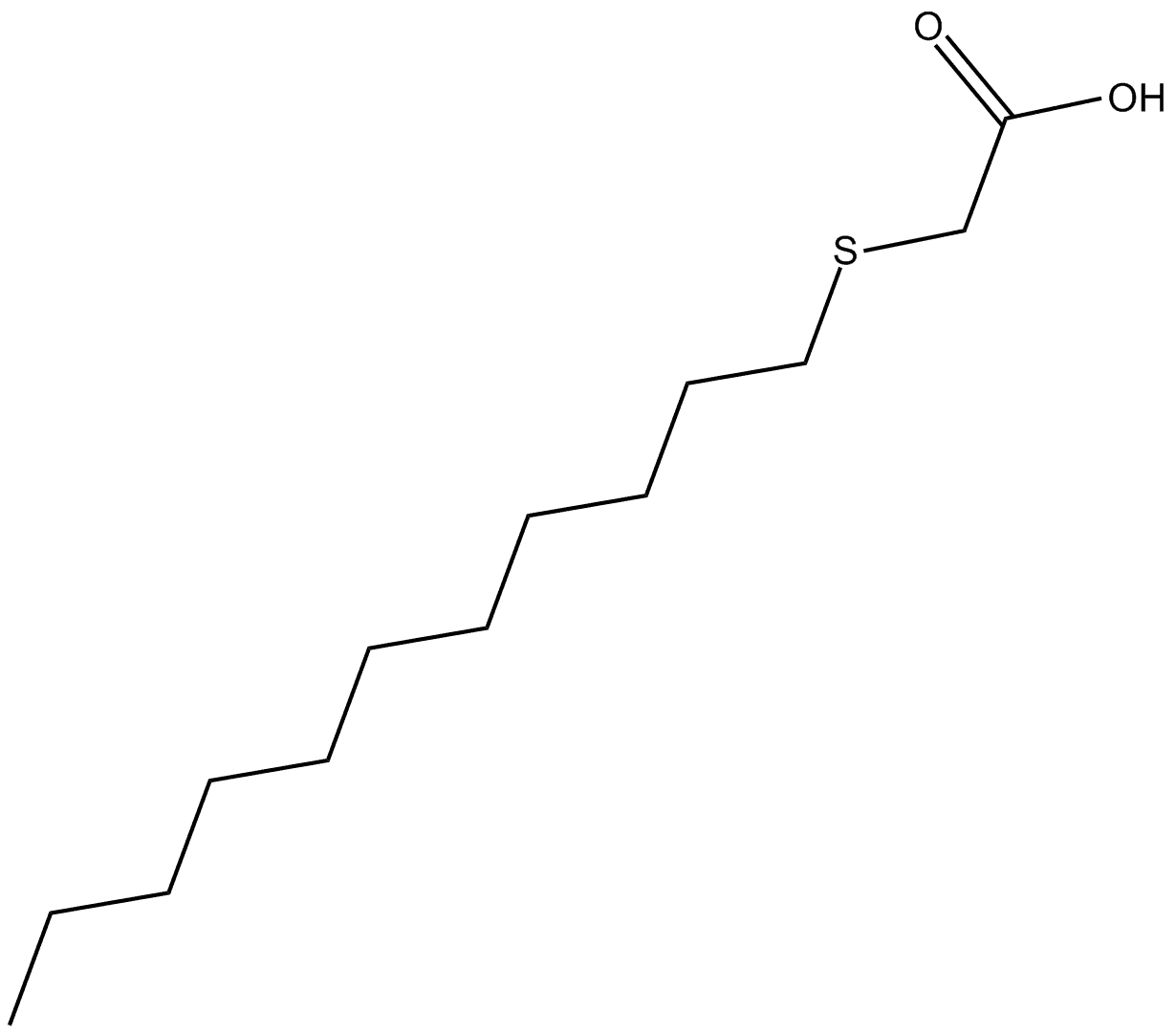
3-Thiatetradecanoic Acid
PPAR激活剂
| 规格 | 价格 | 货期 | 数量 |
|---|---|---|---|
| 5mg | ¥3575.00 | 7-15工作日发货 | |
| 10mg | ¥5525.00 | 7-15工作日发货 |
特色产品
- 适用于流式细胞仪和荧光显微镜检测
- 准确区分活细胞/凋亡细胞/坏死细胞

- 用于免疫印迹和质谱分析等后续操作
- 适用于30 KDa-130 KDa大小的蛋白
- 对细胞无毒性
- 步骤更简单,无需有机溶剂

- 可将信号灵敏度提高100倍
- 同时保持稳定的特异性和分辨率
- 提供更高的转录效率并抑制免疫激活
- 使用5-moUTP和Cy5-utp修饰
- 优异的扩增效率、可重复性和稳定性
- 卓越的灵敏度和准确性,操作简单

- 优化的缓冲液和T7 RNA聚合酶混合物
- 20 μL反应体系可获得更高的RNA产量
产品描述
3-Thiatetradecanoic Acid is an activator of PPAR.
The peroxisome proliferator-activated receptors (PPARs) are transcription factors involved in fatty acid metabolism and energy homeostasis. The PPARs also play crucial roles in the control of cellular growth and differentiation.
In vitro: In BT4Cn cells, 3-thiatetradecanoic acid could activate all PPAR subtypes dose-dependently. In cell culture experiments, the PPARγ-selective ligand BRL49653 moderately inhibited growth of BT4Cn cells, while administration of 3-thiatetradecanoic acid led to a marked growth inhibition. Moreover, the administration of the PPARγ-selective antagonist GW9662 abolished BRL49653-induced growth inhibition, but only marginally reduced the effect of 3-thiatetradecanoic acid [1].
In vivo: Administration of 3-thiatetradecanoic acid increased mitochondrial and peroxisomal beta-oxidative capacity and carnitine palmitoyltransferase activity, but reduced free fatty acid and triacylglycerol levels in plasma compared to palmitic acid-treated rats and controls. 3-Thiatetradecanoic acid administration was able to affect the fatty acid composition in plasma and liver by increasing the amount of monoenes [2].
Clinical trial: A previous study described the clinical, hematological, and biochemical safety of 3-thiatetradecanoic acid. 3-Thiatetradecanoic acid was given as a single oral dose for 7 consecutive days. No significant changes were observed in the hematological or clinical chemical parameters in blood/urine. 3-Thiatetradecanoic acid did not induce significant changes in the blood lipids or free fatty acids, but it did lead to an increase in plasma concentration of Δ9 desaturated 3-thiatetradecanoic acid. 3-thiatetradecanoic acid was found to be safe and well tolerated [3].
References:
1. Berge K, Tronstad KJ, Flindt EN, Rasmussen TH, Madsen L, Kristiansen K, Berge RK. Tetradecylthioacetic acid inhibits growth of rat glioma cells ex vivo and in vivo via PPAR-dependent and PPAR-independent pathways. Carcinogenesis. 2001 Nov;22(11):1747-55.
2. Asiedu, D.K.,Froyland, L.,Vaagenes, H., et al. Long-term effect of tetradecylthioacetic acid: A study on plasma lipid profile and fatty acid composition and oxidation in different rat organs. Biochimica et Biophysica Acta 1300, 86-96 (1996)._x000B_3. Pettersen RJ, Salem M, Skorve J, Ulvik RJ, Berge RK, Nordrehaug JE. Pharmacology and safety of tetradecylthioacetic acid (TTA): phase-1 study. J Cardiovasc Pharmacol. 2008 Apr;51(4):410-7.
产品性质
| 物理外观 | A crystalline solid |
| CAS号 | 116296-31-2 |
| 分子式 | C13H26O2S |
| 分子量 | 246.4 |
| 小分子别名 | 3-Thiatetradecanoic acid |
| 化学名称 | (undecylthio)-acetic acid |
| 溶解度 | ≤30mg/ml in ethanol;30mg/ml in DMSO;30mg/ml in dimethyl formamide |
| SMILES | CCCCCCCCCCCSCC(O)=O |
| 存储条件 | -20°C |
| 运输条件 | 蓝冰 |
产品应用 (实验数据来自文献,APExBIO并未验证,仅供参考)
IC50和靶点
| 生物活性描述 | 3-Thiatetradecanoic acid 是 N-肉豆蔻基转移酶(NMT)的底物;NMT 参与硫代脂肪酸的代谢。 |





 沪公网安备 31011002003500