

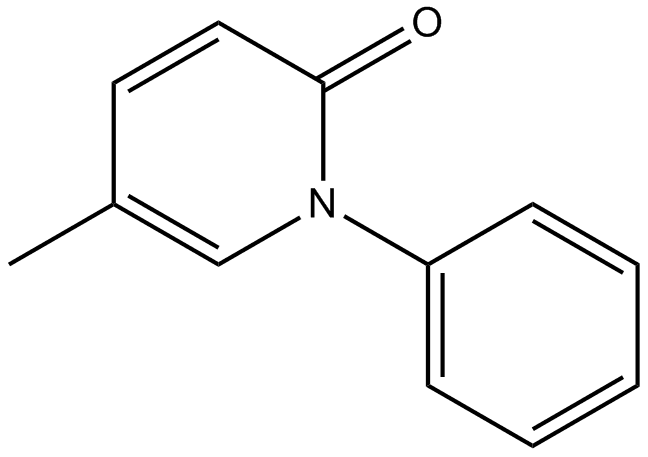
Pirfenidone
TGF-β产生的抑制剂
| 规格 | 价格 | 货期 | 数量 |
|---|---|---|---|
| 1mL(10 mM in DMSO) | ¥500.00 | 现货 | |
| 100mg | ¥572.00 | 现货 | |
| 500mg | ¥954.00 | 现货 | |
| 1g | ¥1472.00 | 现货 |
特色产品
- 适用于流式细胞仪和荧光显微镜检测
- 准确区分活细胞/凋亡细胞/坏死细胞

- 用于免疫印迹和质谱分析等后续操作
- 适用于30 KDa-130 KDa大小的蛋白
- 对细胞无毒性
- 步骤更简单,无需有机溶剂

- 可将信号灵敏度提高100倍
- 同时保持稳定的特异性和分辨率
- 提供更高的转录效率并抑制免疫激活
- 使用5-moUTP和Cy5-utp修饰
- 优异的扩增效率、可重复性和稳定性
- 卓越的灵敏度和准确性,操作简单

- 优化的缓冲液和T7 RNA聚合酶混合物
- 20 μL反应体系可获得更高的RNA产量
产品描述
Pirfenidone是一种口服抗纤维化剂,具有广谱抗纤维化和抗炎作用。Pirfenidone用于治疗某些纤维化疾病,在特发性肺纤维化患者中,Pirfenidone目前已进入处于临床试验中。
体外实验:在RAW264.7细胞中,Pirfenidone(< 300 μg/mL)通过翻译机制抑制促炎细胞因子TNF-α,其不依赖于丝裂原活化蛋白激酶(MAPK)2、p38 MAP激酶和c-Jun N-末端激酶(JNK)的活化[1]。在LN-18、T98G、LNT-229和LN-308细胞系中,Pirfenidone(< 10 mM)以浓度依赖性方式降低神经胶质瘤细胞密度。在CCL-64细胞中,Pirfenidone(< 5 mM)通过影响TGF-β2 mRNA表达和pro-TGF-β的加工而降低TGF-β生物活性。在LN-308细胞中,Pirfenidone(< 8.3 mM)抑制重组弗林蛋白酶的活性,并以剂量依赖性方式下调MMP-11的表达[2]。在培养的子宫肌层和平滑肌平滑肌细胞中,Pirfenidone以剂量依赖性方式抑制血清刺激的DNA合成和细胞增殖的增加[3]。
体内实验:在Pirfenidone治疗的动物中,胶原I、III和IV、转化生长因子β-1、Smad-7、TIMP-1和PAI-1的基因表达显著降低[4]。剂量为30 mg/kg/天的Pirfenidone一日三次给药减弱bleomycin诱导的肺纤维化。Pirfenidone(30、100 mg/kg/天)一天三次抑制肺炎症性水肿和肺纤维化。Pirfenidone抑制bleomycin诱导的肺白介素(IL)-1β、IL-6、IL-12、p40和单核细胞趋化蛋白(MCP)-1水平的增加,并防止bleomycin诱导的肺干扰素(IFN)-γ水平的降低。此外,Pirfenidone抑制肺碱性成纤维细胞生长因子(bFGF)、转化生长因子(TGF)-β1、肺基质细胞衍生因子(SDF)-1α和IL-18的升高[5]。
在小鼠中,250 mg/kg Pirfenidone有效抑制促炎细胞因子、TNF-α、干扰素-γ和白细胞介素-6的生成,但增强抗炎细胞因子、白细胞介素-10的生成[1]。Pirfenidone (250 mg/kg/天)改善了约50%的环孢菌素诱导的纤维化,改善CsA诱导的肌酐清除率降低。在盐耗竭的Sprague-Dawley大鼠中,Pirfenidone还降低80%的TGF-β1蛋白表达 [6]。在静脉内注射博莱霉素的ICR小鼠中,Pirfenidone(400 mg/kg/天)抑制热休克蛋白47阳性细胞和肌成纤维细胞,这两种细胞是负责肺纤维化中细胞外基质积累和沉积的主要细胞[7]。
在用二甲基亚硝胺(10 mg/kg)处理5周的大鼠中,0.5% Pirfenidone降低肝损伤程度。0.5% Pirfenidone流体饮食给药将这些转录物水平的升高下调了50-60%,这与胶原沉积减少70%相关[8]。
临床试验:Pirfenidone是用于治疗糖尿病性肾病的有前景的药物。1200-mg/d Pirfenidone组中,平均eGFR增加(每1.73 m2增加3.3 ± 8.5 ml/min),在安慰剂组中,平均eGFR降低(每1.73 m2增加2.2 ± 4.8 ml/min)(P = 0.026)。在2400-mg/d Pirfenidone组中,中断率高(11/25),eGFR的变化与安慰剂(1.9 ± 6.7 ml/min per 1.73 m2)没有显著差异[9]。
在特发性肺纤维化(IPF)患者中,Pirfenidone已经进入了3个III期、随机、双盲、安慰剂对照研究[10,11]。在Pirfenidone组中,与安慰剂组相比,在绝对下降10个百分点的患者中,相对减少47.9%,而FVC没有下降的患者中,相对增加132.5%(P < 0.001),FVC没有下降。Pirfenidone也减少了6分钟步行距离的下降(P = 0.04),改善无进展生存期(P < 0.001)。最常见的副作用是胃肠道和皮肤相关疾病[11]。
参考文献:
Nakazato H, Oku H, Yamane S, et al. A novel anti-fibrotic agent pirfenidone suppresses tumor necrosis factor-α at the translational level[J]. European journal of pharmacology, 2002, 446(1): 177-185.
Burghardt I, Tritschler F, Opitz C A, et al. Pirfenidone inhibits TGF-β expression in malignant glioma cells[J]. Biochemical and biophysical research communications, 2007, 354(2): 542-547.
Lee B S, Margolin S B, Nowak R A. Pirfenidone: a novel pharmacological agent that inhibits leiomyoma cell proliferation and collagen production[J]. The Journal of Clinical Endocrinology & Metabolism, 1998, 83(1): 219-223.
Garca L, Hernández I, Sandoval A, et al. Pirfenidone effectively reverses experimental liver fibrosis[J]. Journal of hepatology, 2002, 37(6): 797-805.
Oku H, Shimizu T, Kawabata T, et al. Antifibrotic action of pirfenidone and prednisolone: different effects on pulmonary cytokines and growth factors in bleomycin-induced murine pulmonary fibrosis[J]. European journal of pharmacology, 2008, 590(1): 400-408.
Shihab F S, Bennett W M, Yi H, et al. Pirfenidone Treatment Decreases Transforming Growth Factor‐β1 and Matrix Proteins and Ameliorates Fibrosis in Chronic Cyclosporine Nephrotoxicity[J]. American Journal of Transplantation, 2002, 2(2): 111-119.
Kakugawa T, Mukae H, Hayashi T, et al. Pirfenidone attenuates expression of HSP47 in murine bleomycin-induced pulmonary fibrosis[J]. European Respiratory Journal, 2004, 24(1): 57-65.
Di Sario A, Bendia E, Macarri G, et al. The anti-fibrotic effect of pirfenidone in rat liver fibrosis is mediated by downregulation of procollagen α1 (I), TIMP-1 and MMP-2[J]. Digestive and liver disease, 2004, 36(11): 744-751.
Sharma K, Ix J H, Mathew A V, et al. Pirfenidone for diabetic nephropathy[J]. Journal of the American Society of Nephrology, 2011, 22(6): 1144-1151.
Azuma A, Nukiwa T, Tsuboi E, et al. Double-blind, placebo-controlled trial of pirfenidone in patients with idiopathic pulmonary fibrosis[J]. American journal of respiratory and critical care medicine, 2005, 171(9): 1040-1047.
King Jr T E, Bradford W Z, Castro-Bernardini S, et al. A phase 3 trial of pirfenidone in patients with idiopathic pulmonary fibrosis[J]. New England Journal of Medicine, 2014, 370(22): 2083-2092.
产品性质
| 物理外观 | A solid |
| CAS号 | 53179-13-8 |
| 分子式 | C12H11NO |
| 分子量 | 185.22 |
| 化学名称 | 5-methyl-1-phenylpyridin-2-one |
| 溶解度 | ≥36 mg/mL in EtOH; ≥38.4 mg/mL in DMSO; ≥7.68 mg/mL in H2O with gentle warming |
| SMILES | CC(C=C1)=CN(c2ccccc2)C1=O |
| 存储条件 | -20°C |
| 运输条件 | 蓝冰 |
产品应用 (实验数据来自文献,APExBIO并未验证,仅供参考)
IC50和靶点
| 生物活性描述 | 吡非尼酮(AMR69)是一种抗纤维化药物;可减轻纤维细胞中 CCL2 和 CCL12 的产生。吡非尼酮具有生长抑制作用;可降低人胶质瘤细胞系中 TGF-β2 蛋白水平。吡非尼酮还具有抗炎活性。 |





 沪公网安备 31011002003500