
Cy7 NHS ester (non-sulfonated)
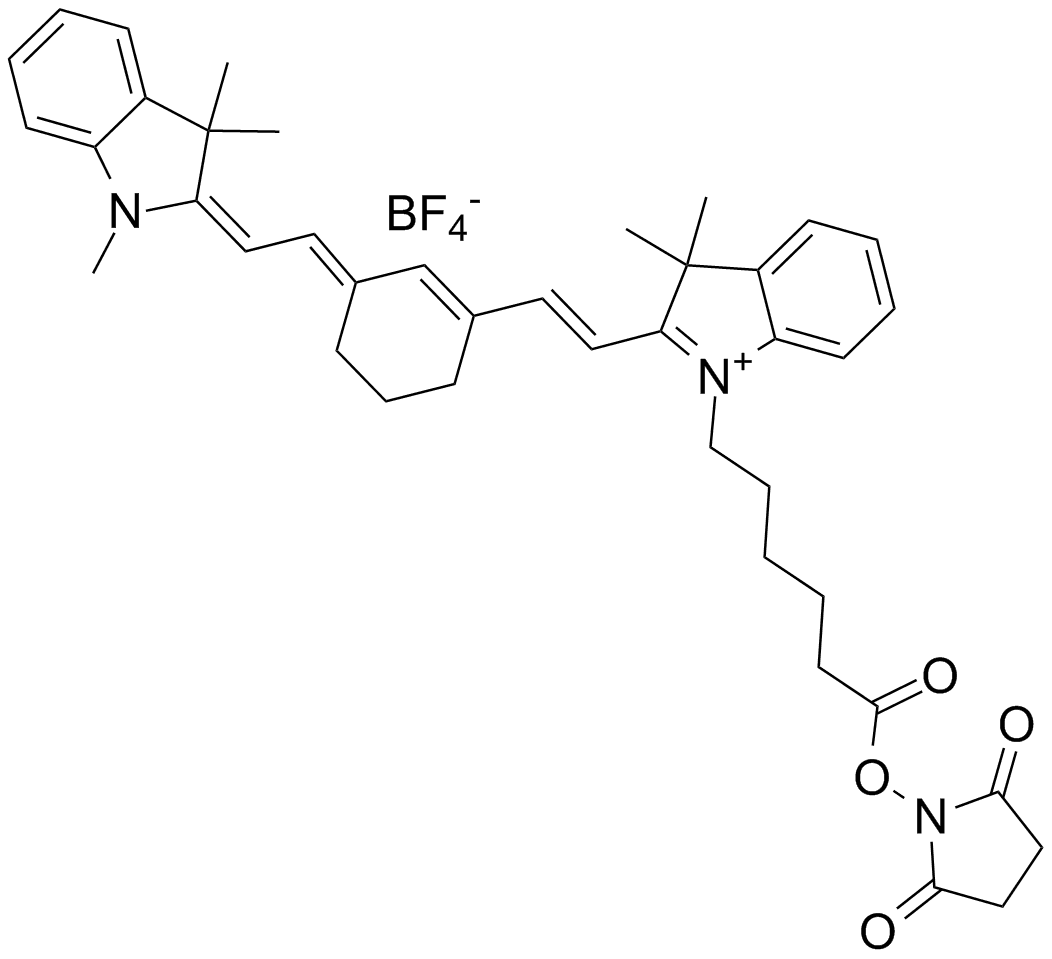
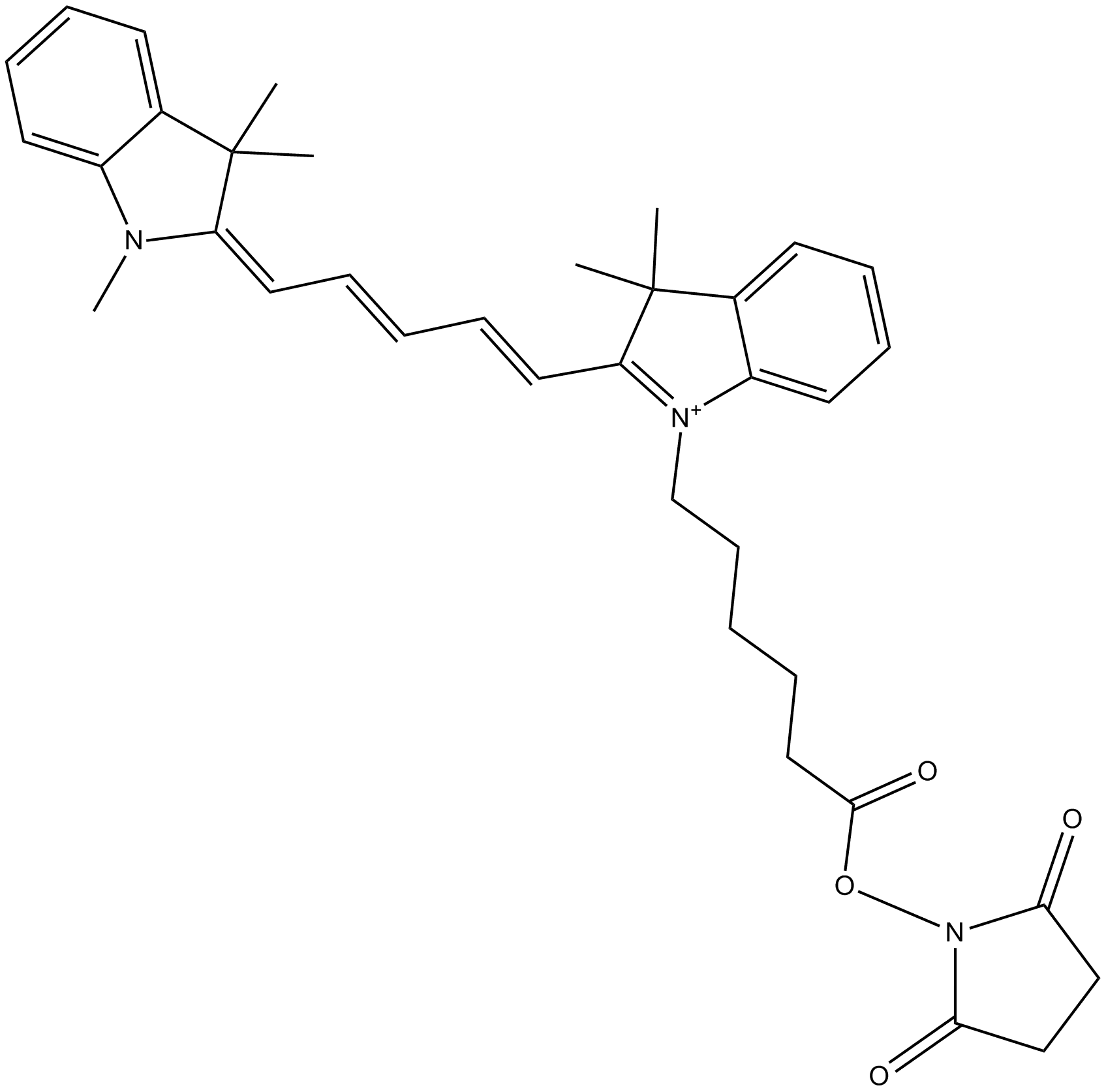
Cy7 NHS活化酯(非磺化,四氟硼酸盐),标记伯氨基,近红外荧光。
| 规格 | 价格 | 货期 | 数量 |
|---|---|---|---|
| 5mg | ¥5750.00 | 现货 | |
| 25mg | ¥11250.00 | 现货 |
特色产品
- 适用于流式细胞仪和荧光显微镜检测
- 准确区分活细胞/凋亡细胞/坏死细胞

- 用于免疫印迹和质谱分析等后续操作
- 适用于30 KDa-130 KDa大小的蛋白
- 对细胞无毒性
- 步骤更简单,无需有机溶剂

- 可将信号灵敏度提高100倍
- 同时保持稳定的特异性和分辨率
- 提供更高的转录效率并抑制免疫激活
- 使用5-moUTP和Cy5-utp修饰
- 优异的扩增效率、可重复性和稳定性
- 卓越的灵敏度和准确性,操作简单

- 优化的缓冲液和T7 RNA聚合酶混合物
- 20 μL反应体系可获得更高的RNA产量
产品描述
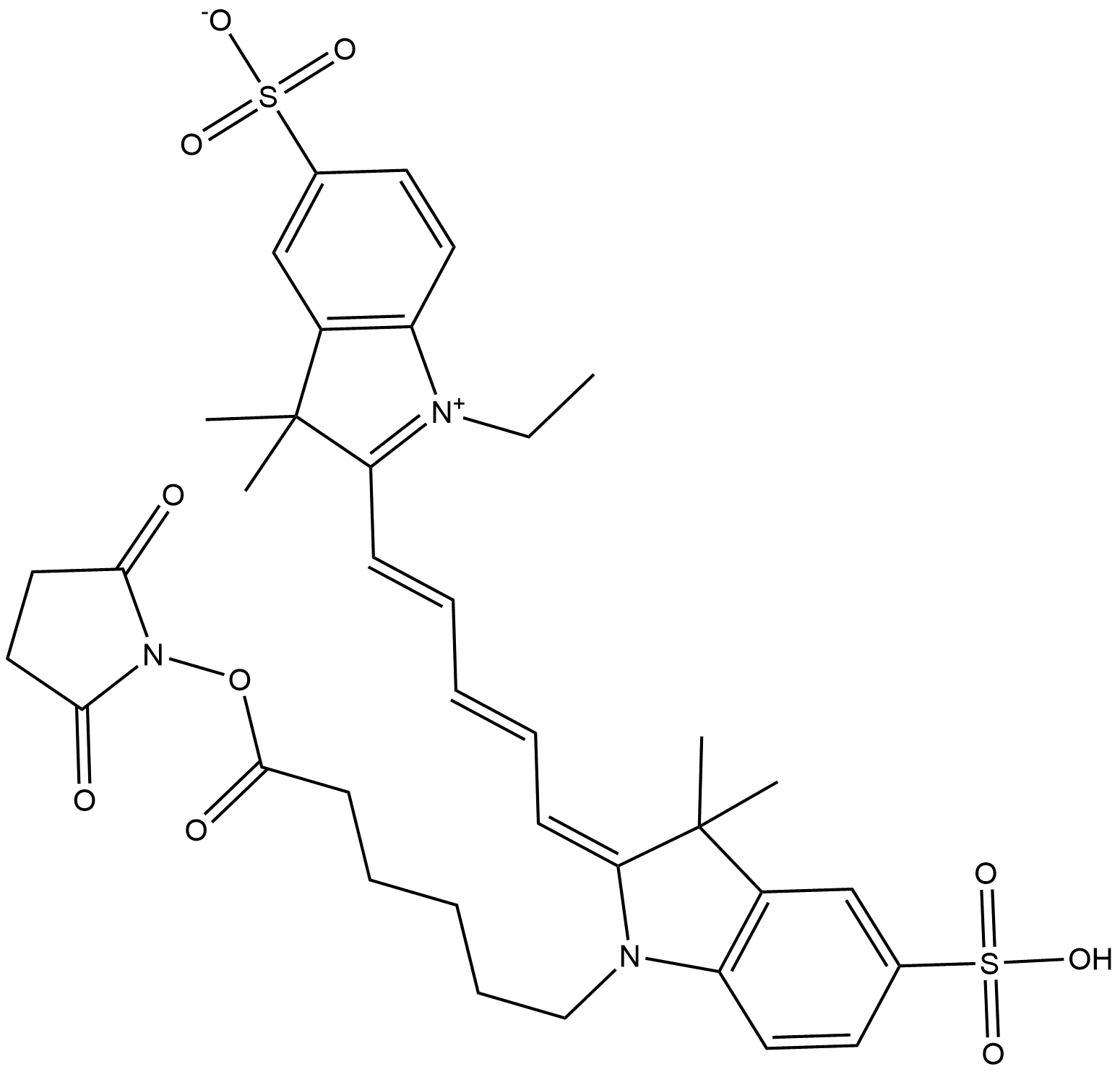
Cy7 NHS ester, also called Cy7 monofunctional N-hydroxysuccinimide ester or Cy7-NHS [1], is a near-infrared fluorescent [2] and soluble sulfonated cyanine dye [3] with a molecular weight of 828 Da[2], able to be dissolved in DMSO [1] and ready for conjugation to proteins [4]. Cy7 NHS ester acts as a donor of Cy7 [5]. Cy7 has an emission maximum at 767nm, an absorption maximum at 743nm and its ε743=200,000 cm-1M-1 [4]. Compared with Cy5.5, Cy7 has fewer sulfonate groups and an extra methine group that contributes to hydrophobicity. Antibodies labeled with either Cy7 or Cy5.5 succinimidyl esters have similar quenching efficiencies [5].
N-acylation can occur between a Cy7 NHS ester and a primary amino group. This type of reaction is also widely used to allow amide formation under milder conditions without base or coupling reagent [6]. Most derivatives of non-sulfonated cyanines have low aqueous solubility except for hydrochlorides of hydrazides and amines. For biomolecule labeling, using of organic co-solvent (5-20% of DMF or DMSO) to dissolve this molecular is necessary for efficient reaction. Cyanine dye should be dissolved in organic solvent first, and added to a solution of biomolecule (protein, peptide, amino-labeled DNA) in appropriate aqueous buffer.
Incubated with Cy7 NHS, LS174T cells showed negligible signals in fluorescent microscopic images, it illustrated that possibility of nonspecific binding between free Cy7 and LS174T cells was negligible [1].
In vivo, injection of Cy7-NHS for 15 minutes resulted in the fluorescent signal in the whole body of a mouse bearing LS174T tumors, but from the blank mouse, no autofluorescence was detected. This result suggested the rapid distribution of Cy7 NHS in the body of the mouse. Subsequently, Cy7 NHS was rapidly eliminated from the kidney and no fluorescence was detected on the mouse 96 hours post-injection [1].
References:
[1]. Peng Zou, Songbo Xu, Stephen P. Povoski, et al. Near-Infrared Fluorescence Labeled Anti-TAG-72 Monoclonal Antibodies for Tumor Imaging in Colorectal Cancer Xenograft Mice. Mol Pharm., 2009, 6(2): 428-440.
[2]. Martin L. Brady, Raghu Raghavan, Deep Singh, et al. In vivo performance of a microfabricated catheter for intraparenchymal delivery. Journal of Neuroscience Methods, 2014, 229: 76-83.
[3]. Valeri Metelev, Surong Zhang, David Tabatadze, et al. The three-dimensional context of a double helix determines fluorescence of the internucleoside-tethered pair of fluorophores. Mol Biosyst., 2013, 9(10): 2447-2453.
[4]. Manfred Birchler, Giovanni Neri, Lorenzo Tarli, et al. Infrared photodetection for the in vivo localisation of phage-derived antibodies directed against angiogenic markers. Journal of Immunological Methods, 1999, 231: 239-248.
[5]. Benedict Law, Alejandro Curino, Thomas H. Bugge, et al. Design, Synthesis, and Characterization of Urokinase Plasminogen-Activator-Sensitive Near-Infrared Reporter. Chemistry & Biology, 2004, 11: 99-106.
[6]. M. Bai and D.J. Bornhop. Recent Advances in Receptor-Targeted Fluorescent Probes for In Vivo Cancer Imaging. Current Medicinal Chemistry, 2012, 19(1): 1-17.
产品性质
| 物理外观 | A solid |
| CAS号 | 2408482-09-5 |
| 分子式 | C41H48BF4N3O4 |
| 分子量 | 733.64 |
| 小分子别名 | Cyanine 7 NHS ester tetrafluoroborate; Cyanine 7 NHS ester; Cy 7 NHS ester |
| 溶解度 | ≥34.1 mg/mL in DMSO |
| SMILES | CC1(C)C(/C=C/C(CCC/2)=CC2=C\C=C3N(C)C4=CC=CC=C4C\3(C)C)=[N+](CCCCCC(ON(C5=O)C(CC5)=O)=O)C6=CC=CC=C61.FB(F)F.[F-] |
| 存储条件 | -20°C干燥避光 |
| 运输条件 | 蓝冰 |
| 最大发射波长 | 773 nm |
| 最大激发波长 | 750 nm |
| 消光系数 | 199000 |
| 量子产量 | 0.3 |
生物相关数据
质量控制
APExBIO 顾客使用本产品发表的 1 篇科研文献
- 1.Liang X, Li X,et al."Nanoparticles with CD44 Targeting and ROS Triggering Properties as Effective inVivo Antigen Delivery System." Mol Pharm. 2018 Feb 5;15(2):508-518. PMID:29323913





 沪公网安备 31011002003500